April 16, 2026
Dear Customers,
Today, NW Natural joined a lawsuit with a number of employers, labor groups and business associations, challenging the State of Oregon’s Climate Protection Program (CPP), which was first introduced through an executive order to regulate carbon by former Governor Kate Brown. We are requesting that the Oregon Court of Appeals move quickly to address legal flaws in the CPP.
We joined this lawsuit on behalf of our customers, who will bear unsustainable cost increases due to this program. The program mandates aggressive, rapid and technically unachievable emissions reductions for gasoline, diesel, natural gas, and propane fuel users, and burdens Oregonians with the most expensive carbon compliance fee in North America.
As a result, the CPP is driving up energy costs at a time when Oregon is already facing significant job losses, a housing affordability crisis, and among the highest tax burdens on consumers and businesses in the nation.
The CPP is also ineffective as a climate program because it does not require reductions in emissions associated with the coal and natural gas used to produce Oregon’s electricity. Instead, compliance falls on lower emitting downstream natural gas customers—industrial applications, homes and businesses, which makes little sense if the state’s goal is to reduce emissions associated with overall energy use.
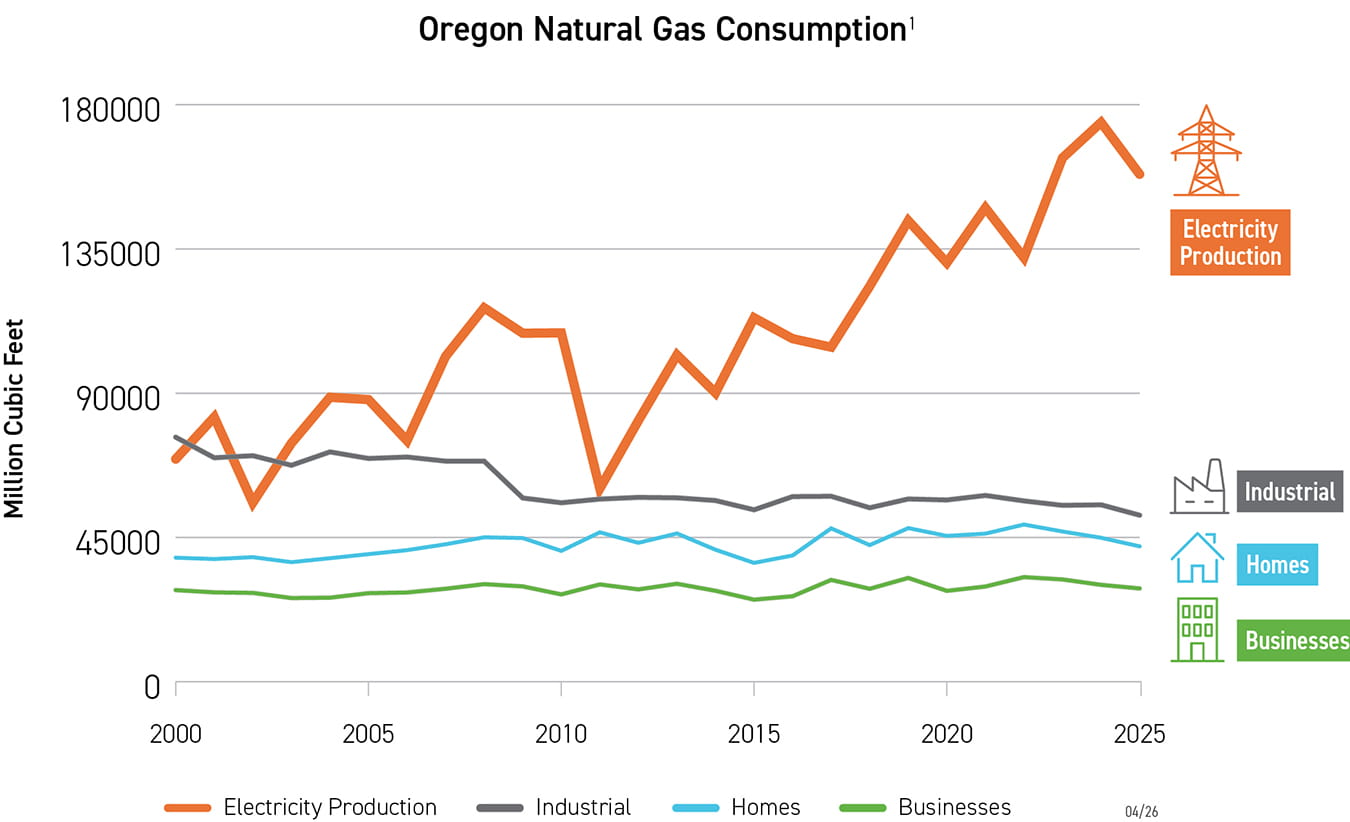
To comply with the CPP on our customers’ behalf, NW Natural will use compliance instruments, energy efficiency measures, the purchase of lower carbon fuels such as renewable natural gas (RNG), and compliance credits created by the Oregon Department of Environmental Quality (ODEQ) called Community Climate Investments (CCIs).
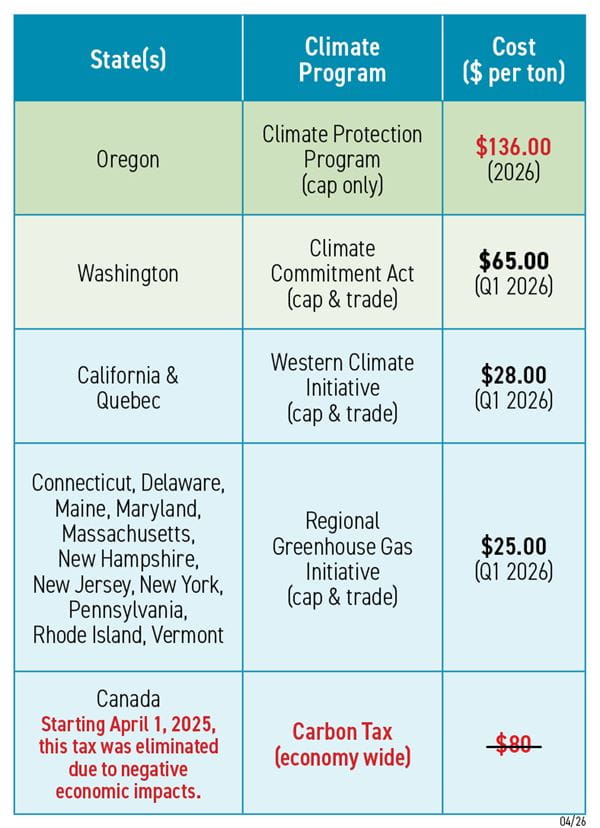
These CCI credits function as a fee that will be collected from customers to comply with the program at a cost of $136.00 per ton of carbon, compared to programs in Washington and California: about $65.00 and $28.00, respectively.
As recently reported by the Oregon Journalism Project and Willamette Week: "That means Oregon businesses that must purchase allowances will pay double, or even five times, what their peers in other states pay."Oregon Journalism Project (April 2, 2026)
How does Oregon's climate program costs compare to other programs?
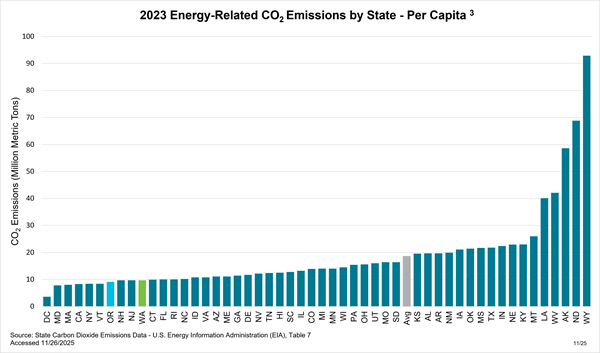
While Oregon is among the lowest emitting states in the U.S., the carbon compliance fee for its program is the highest in North America.[2]Source details available below.
Could the CPP cause an increase in emissions?
An unintended consequence of making energy unaffordable in Oregon is that many industrial and commercial businesses may simply expand elsewhere or move to other more affordable but higher-emitting states. This potentially negative climate outcome was not properly incorporated into the program’s unrealistically rapid emission reduction requirements and associated compliance costs.
Lack of program accountability
The CCI compliance fees and associated dollars collected from Oregon consumers and businesses will go to non-profits selected by ODEQ to fund projects. There is no requirement that those projects will reduce emissions, creating serious effectiveness concerns. Additionally, the Oregon Legislature has no oversight of these funds, which are expected to total billions of dollars in just a few compliance periods.
The program also penalizes Oregon economic growth, as there is no consideration or allowance for existing businesses to expand or to accommodate additional energy use needed to serve new businesses coming into our state.
There has been no state determination of overall cost impacts related to this program on Oregonians. Unlike most other carbon regulations across the U.S., this program does not allow for market linkage with other states or use of verified carbon offsets – all important cost control mechanisms.
At a time when Oregon urgently needs economic growth, this program will impose unprecedented cost increases to energy that will further damage our state’s competitive position without requiring commensurate and substantiated climate benefits.
We know there is a better way
NW Natural believes the CPP needs to be replaced with a true cap-and-trade system approved by the Oregon Legislature that aligns with what other states are doing.
It’s our view that an effective climate program should have legislative oversight, realistic emission reduction targets, accountability for the funds collected to actually reduce emissions, and a structure that supports Oregon’s economic recovery and growth.
NW Natural remains committed to lowering carbon emissions. We thank our customers for what you have already done to make natural gas the lowest emitting energy sector in Oregon.
NW Natural's system delivers 45% more energy[4]Source: Oregon Public Utility Commission; full source details available below than any other utility in Oregon over the course of a year, yet it uses less gas and emits less carbon.

We know more must be done, and we know it can be done in a much more efficient, affordable, reliable, and accountable way.
Others agree:
Lawmakers from both parties, including the Oregon Legislature’s senior environmental policymaker, state Sen. Janeen Sollman (D-Hillsboro), think the program is seriously flawed. “I’d like to see more accountability, transparency and flexibility and more ability for the Legislature to direct where the money goes,” Sollman tells OJP. “There is no legislative accountability with the CPP—and that is concerning.”
“There ought to be far more legislative oversight and direction to make sure the investments benefit the state as a whole,” says state Rep. John Lively (D-Springfield), who chairs the House Committee on Climate, Energy and Environment. “I think we are missing the mark.”
“The big thing California and Washington have in their programs is stability,” Sollman adds. “Gov. Kotek said Oregon is open for business. Well, to me that means stability and consistency.”
Oregon Journalism Project (April 2, 2026)
We continue to ask our policymakers to immediately pause the CPP, stop these cost impacts Oregonians can’t afford, and replace it with a workable, effective program.
Sources
1: U.S. Energy Information Administration; Oregon Natural Gas Consumption by End Use; 2000-2025.
Data available at: https://www.eia.gov/dnav/ng/ng_cons_sum_dcu_SOR_a.htm (Last accessed: 4/8/26)
2: Oregon Climate Protection Program; Community Climate Investment Contribution Amount. Data Available at: https://www.oregon.gov/deq/ghgp/Documents/CCIContributionAmounts-UA.pdf (Last accessed: 4/14/26).Washington Climate Commitment Act; Q1 2026 Auction. Data available at: https://apps.ecology.wa.gov/publications/documents/2614003.pdf (Last accessed: 4/13/2026). Western Climate Initiative; Q1 2026 Auction. Data available at: https://ww2.arb.ca.gov/sites/default/files/2020-08/results_summary.pdf (Last accessed: 4/13/26). Regional Greenhouse Gas Initiative; Q1 2026 Auction. Data available at: https://www.rggi.org/auctions/auction-results/prices-volumes (Last accessed: 4/13/26). Canada carbon tax status: https://www.cbc.ca/news/business/carbon-tax-ending-1.7498279
3: Energy Information Administration; 2023 state carbon dioxide emissions data, table 7.
Data available at: https://www.eia.gov/environment/emissions/state/ (Last accessed: 11/26/25)
4: Oregon Public Utility Commission; 2024 Oregon Utility Statistics.
Data available at: https://www.oregon.gov/puc/forms/Forms%20and%20Reports/2024-Oregon-Utility-Statistics-Book.pdf (Last accessed: 10/26/25)
5: Oregon Department of Environmental Quality; Oregon Greenhouse Gas Sector-Based Inventory: 1990 through 2021 with preliminary 2022 and 2023 data. Data available at: https://www.oregon.gov/deq/ghgp/Pages/GHG-Inventory.aspx (Last accessed: 2/17/2026)